Yesteryear
If you enjoyed this review, please consider purchasing this book from my Amazon Associates link (applies to Kindle purchases as well): https://amzn.to/4bHtEF4. The commissions I receive from your purchase help pay for the costs of running this website. Thanks for your support!
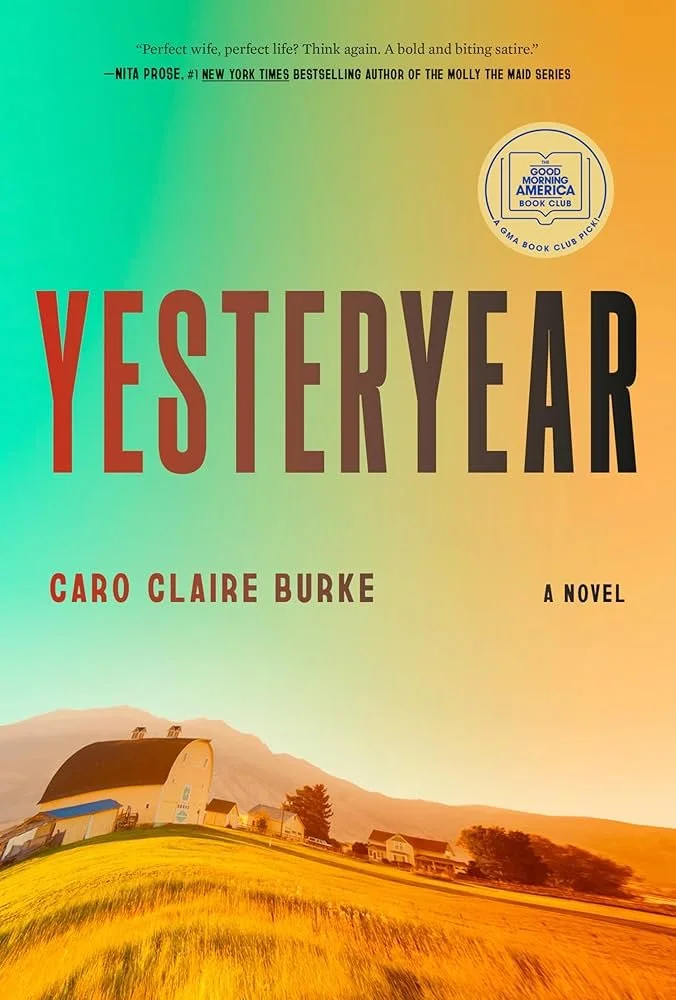
Okay, Yesteryear discourse– I see you, and I must engage. In case you’re living under a rock, Yesteryear follows Natalie, a tradwife influencer whose offline persona largely contradicts the online narrative that she projects. I’m going to start this thing off with a spoiler-free perspective, but then I will be forced to get into the spoiler-filled weeds.
Natalie is a bitch. Like seriously, vile. Super judgmental, seemingly incapable of loving her children, ruthless in the pursuit of her own warped visions of success, and avoidant of any genuine self-reflection. Unfortunately, she’s also clever and funny, so… I like her. What does that say about me? Jail.
The thing is that yes, she’s a bitch, but I understand how she got that way. She’s very smart, and that intelligence conflicted with her indoctrinated values, so she’s plagued by a constant bubbling bitterness. She wanted more for herself but had self-imposed limitations on what that meant. Does that excuse any of her behavior? No. But it certainly makes for interesting writing. I don’t need to like the main character. Actually, the fact that no one can stand her speaks to the author’s ability to create a character who evokes such a visceral reaction from readers.
I’m also seeing people complain that there is no moral to the story; to that, I quote Maximus Decimus Meridius– “Are you not entertained?” I’m not necessarily looking for principled guidance from the Good Morning America Book Club. It was riveting and creative, and that can be enough. Furthermore, I actually disagree with the notion that there is no moral takeaway. The book depicts three categories of women: Reena, a career-obsessed woman whose ladder-climbing comes at the expense of a stable home life/parenthood; Producer Shannon (I’m incapable of just calling her Shannon), who claims to want out of the corporate rat race but is naive about the implications; and Natalie, devoted to stereotypical gender roles even when it’s literally driving her nuts. All of these women are deeply unhappy, so this book is not glorifying any one of those paths. It would be easy to throw up your hands and say, okay, where does that leave us? We as women are screwed; there’s no way to be a happy woman. But I think the underlying message is that extremes in any form are unfulfilling, whether that be the woke leftist eschewing all conventional values on their face or the singularly-focused conservative disgusted by any choice outside of the traditional realm. I also liked the author’s interweaving of parallels between Reena and Natalie, showing their shared humanity as their actions were opposite sides of the same coin. I will say that Producer Shannon was probably the weakest character and deserved a little more development. She also definitely would have signed an iron-clad NDA, so that’s a lil plot hole that I’m willingly looking past.
So, now we’ll start dabbling with some spoilers. BEWARE! I loved the twist, albeit I was annoyed that I knew a twist was coming– I like to go into books blind. Natalie is so obviously an unreliable narrator (a device that I’ve enjoyed ever since I slurped up The Catcher in the Rye). So, the psychosis makes sense to me as a natural progression. While I didn’t love the 1850s sections (I can only handle so much complaining), I did love that I didn’t see this particular twist coming, even when it tracks in retrospect. Also, the author is clever in her sprinkling of easter eggs, like when Natalie tells the contractor, “I want it to feel like stepping into a time machine.” Little nuggets like that really set the scene for multiple interpretations and genuine surprise. This book has layers, and I learned from my perfect yappy lil book club that there were even more moments open to varied interpretation. For example, while I don’t believe that Natalie’s assault of Producer Shannon was actually sexual in nature (I think in a literal sense, Producer Shannon was mid-change), I can see how some might think it’s her sexual repressions coming to light. Layered like an onion, baby!
Overall, I really loved this book and give it 5 out of 5 flames. I don’t think it was perfect (perhaps a little too heavy-handed on its direct critique of Ballerina Farm, a misleading back-of-the-book description to conceal the twist, and a weakish depiction of Producer Shannon, especially when she went against her character arc by sleeping with Caleb). Still, it launched one of the more animated discussions that our book club has ever had. There’s so much to unpack– Natalie’s relationship to God/religion, her intrusive thoughts, empathy or lack thereof for a postpartum journey that seems like genuine disgust for the child, the ethics of using your children in social media to drive engagement, the echo chambers of misogynists, etc. Plus, the book really landed the plane for me; sometimes I get annoyed when authors insist on closing every loop (ahem, Kristin Hannah), but Yesteryear succeeded in addressing all of my questions in a genuinely surprising manner without me feeling like there were unresolved pieces.