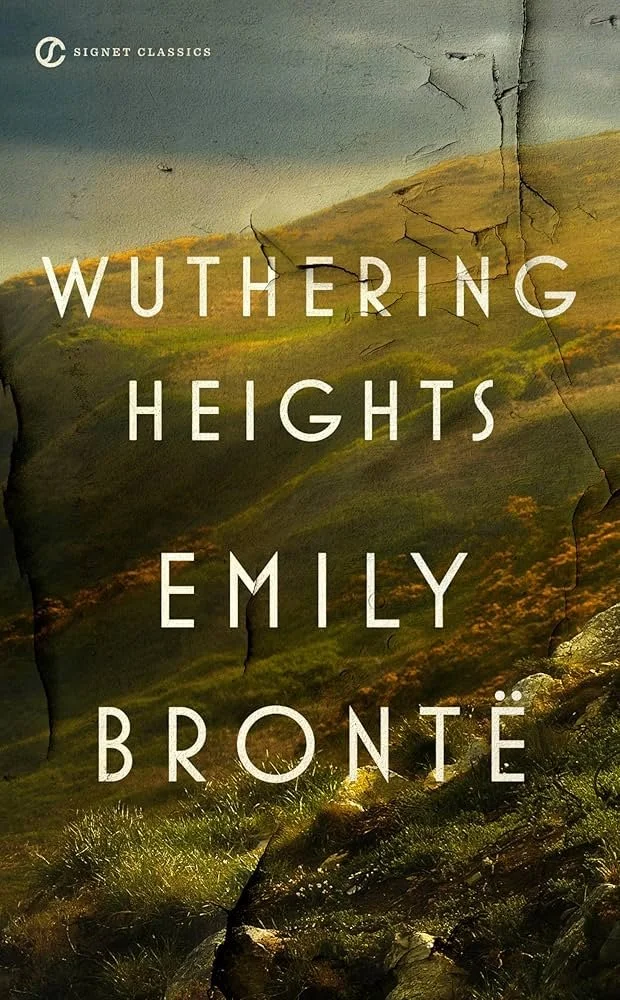
Wuthering Heights
If you enjoyed this review, please consider purchasing this book from my Amazon Associates link: https://amzn.to/4t1H98C. The commissions I receive from your purchase help pay for the costs of running this website. Thanks for your support!
I’m shocked that the plot of this book was not spoiled for me, given that I’m 178 years late. I’m also shocked that I didn’t read this book in high school because I was very much *oh look at me reading Jane Eyre underneath a willow tree* vibes. I obviously read the book now because of the movie (which was EXCELLENT), and my main takeaway from the text is that while the book itself is not so great, I was transported in time, and this is my preferred way to consume history lessons.
The book is split into two parts (note: the movie only covers part one, and, thankfully, there are some major rewrites). It’s set in the Yorkshire moors of Northern England, and the setting plays a significant role. The characters are very isolated; they are stuck both literally and figuratively. They’re confined to their limited physical space (especially women) and emotionally constrained due to social norms. So, you have cousins marrying neighboring cousins, ending up with a bunch of immature weirdos. You don’t know what you don’t know, and in the case of Catherine, one of our protagonists, you really don’t know a lot.
This leads me to my protagonist problem. The names are gonna be a no from me, dawg. Again, this was a moment in time, and apparently, the tradition was to just name your kid the same name as yourself. So, there are two Catherines, and both are protagonists. If that isn’t confusing enough, they also name a kid Linton, which is the last name of one of the other protagonists, and then Kid Linton’s last name becomes the name of a different character’s first name. Obviously, you didn’t follow that. I didn’t really either, and I read the thing! It really detracts from the actual enjoyment of the book.
That being said, the genre is still very fascinating to me. The language they used feels whimsical (I particularly like ‘bonnie lass,’ but also one guy calls his niece an ‘insolent slut,’ and I’m not sure you can chalk that up to *different time, different place*). I enjoyed the historical idioms and the soliloquies that come off as soooo dramatic through today’s lens. On the other hand, I hated Joseph, one of the servants. He was such a drag of a person, but I also legit couldn’t understand a word he said. In general, though, I appreciate the servant perspective. The entire story is narrated by Nelly, a servant, who is more deviously portrayed in the film. This indirect narration gives us insight into the dynamics of servanthood; they actually have significant control and leverage over situations. While they don’t have much power and wealth themselves, they are the levers of the household and oftentimes determine the flow of information or lack thereof.
Another thing I learned that’s very duh but was particularly underscored: people died really easily back in the day. An unseasonably cold winter is a death sentence. You can literally get a fever from being a silly goose. As such, death is treated more nonchalantly because it’s so commonplace. You marry with the expectation that your spouse will die any minute. Their lives are hard and full of suffering, so they place a heavy emphasis on the afterlife as being much better than their present condition; so, death is a mere stepping stone along the way, and that affects how they react to harsh news.
Overall, the book is educational but not a great story in and of itself. This was mid-19th-century smut! And Sarah J. Maas is quaking. The characters are largely unsympathetic, and it simply could not have been adapted to film without some major changes. Part two was a big-time slog, and I appreciate the editors of our day. I’m glad to have read it, and I’m glad to be done. It receives 2 out of 5 flames.